Capital One Venture X Business vs VentureOne Business: Which Fits?
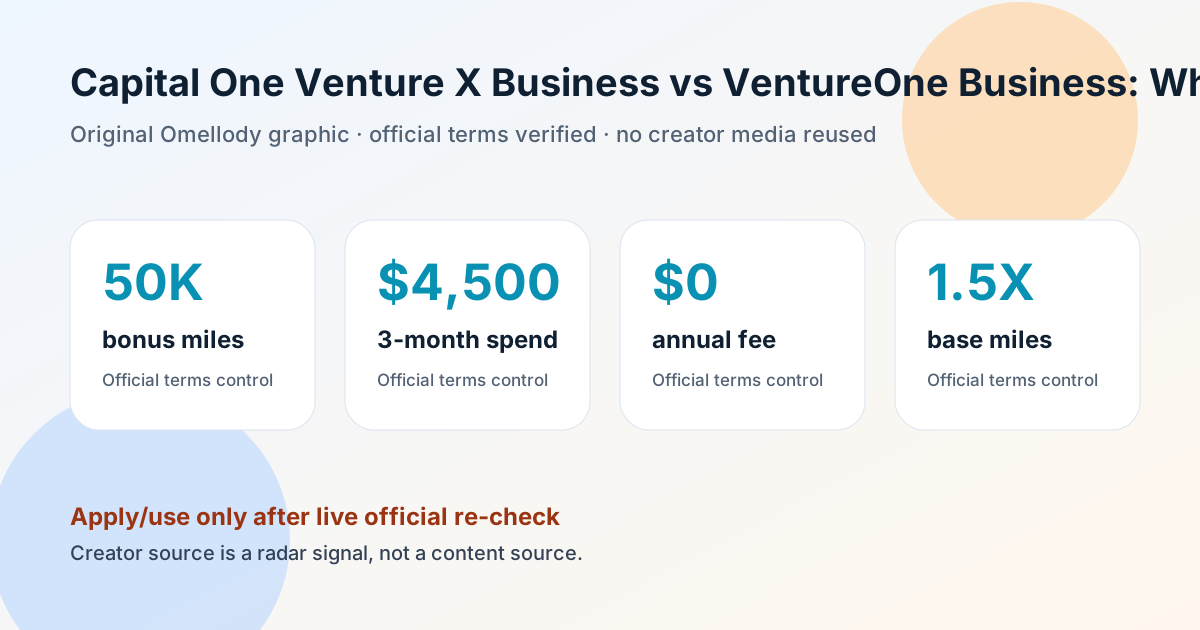
By Omellody Editorial Team · Published · UpdatedFast answer: Venture X Business is the aggressive option: 150,000 miles after $30,000 in the first 3 months, 2X base earning, a $395 annual fee, $300 Capital One Business Travel credit and anniversary miles. VentureOne Business is the lower-risk option: 50,000 miles after $4,500 in the first 3 months, $0 annual fee and 1.5X base earning. The right answer depends on organic business spend, travel portal use and annual-fee tolerance.
Verified Capital One pages · comparison / worth-it guide
Radar source status: This comparison combines two USCreditCards101 Capital One business-card leads, used only as backlog signals. Omellody verified both cards through Capital One official pages and wrote a new English decision guide.
Official verification capturedOriginal hero graphicNo copied creator content
Officially verified facts
| Venture X Business bonus | Official page shows 150,000 miles after $30,000 spend in the first 3 months. |
|---|---|
| VentureOne Business bonus | Official page shows 50,000 miles after $4,500 in purchases within the first 3 months from account opening. |
| Annual fee difference | Official Venture X Business content shows a $395 annual fee; VentureOne Business shows $0 annual fee. |
| Base earning difference | Venture X Business shows 2X miles on every purchase; VentureOne Business shows 1.5X miles on every purchase. |
| Portal travel earning | Venture X Business shows 10X hotels/rental cars and 5X flights/vacation rentals through Capital One Business Travel; VentureOne Business shows 5X hotels/vacation rentals/rental cars through Capital One Business Travel. |
| Premium benefits | Venture X Business shows a $300 annual Capital One Business Travel credit and 10,000 anniversary miles; VentureOne Business does not present those same premium offsets in the captured page. |
How to choose between the two cards
- Start with organic spend: if $30,000 in three months is not normal business spend, remove Venture X Business from the shortlist.
- Price the annual fee: count the $300 travel credit only if Capital One Business Travel works for trips you would already book.
- Compare base earning: 2X can matter for high uncategorized spend, while 1.5X with $0 annual fee can be cleaner for smaller businesses.
- Review travel-portal behavior: if you rarely book through a portal, Venture X Business benefits are less valuable and VentureOne Business may be safer.
- Re-check live official pages before applying because welcome offers, APRs, fees and eligibility rules can change.
Why it matters now
Business owners often compare cards by headline bonus alone. That is risky here because the spend thresholds are dramatically different. A 150K bonus is not automatically better if the business has to create spend, hold inventory or risk cash-flow pressure.
Annual-fee value analysis
Venture X Business can be compelling when the $300 travel credit and anniversary miles are genuinely usable. VentureOne Business has a lower ceiling but avoids an annual-fee break-even calculation.
Who should pick Venture X Business
Pick Venture X Business if your business has high organic spend, likes Capital One miles, can use Capital One Business Travel without overpaying, and wants 2X base earning.
Who should pick VentureOne Business
Pick VentureOne Business if your business wants a smaller $4,500 spend target, no annual fee, simple 1.5X earning and less pressure to use premium travel benefits.
Decision table
| Choose Venture X Business if | You can meet $30,000 organically, use the travel credit, value 2X base earning and accept the $395 fee. |
|---|---|
| Choose VentureOne Business if | You prefer a $0 annual fee, a $4,500 spend threshold and lower operational risk. |
| Choose neither if | You want cash back instead of miles, cannot pay in full, or have no clear use for Capital One miles. |
| User confirm before applying | Live bonus amounts, annual fee, APR/charge terms, eligibility, existing-cardholder language, portal prices and reward-transfer options. |
Related Omellody pages
Official terms links
Use official issuer, bank, hotel, airline or program pages before applying, redeeming or moving spend. If live terms differ from this page, official terms control.
Verification box: checked before publishing
Verified official facts
- Venture X Business: 150,000 miles after $30,000 spend in first 3 months.
- VentureOne Business: 50,000 miles after $4,500 purchases in first 3 months.
- Venture X Business: $395 annual fee and 2X base earning.
- VentureOne Business: $0 annual fee and 1.5X base earning.
- Capital One Business Travel earning and Venture X travel-credit / anniversary-mile language.
User must confirm before applying
- Individual eligibility, approval, exact APR/charge terms, transfer partner values, live travel portal prices, existing-cardholder restrictions and future offer changes.
Financial disclaimer
This page is for general education only and is not financial, tax, legal, credit, banking or travel advice. Credit cards and rewards programs can carry high APRs, fees, eligibility limits, foreign transaction rules, redemption limits and changing terms. Rewards do not justify overspending, carrying debt, buying points speculatively or ignoring official limitations.
FAQ
Which card has the bigger bonus?
Venture X Business. The captured official page showed 150,000 miles after $30,000 in the first 3 months.
Which card has no annual fee?
VentureOne Business. The captured official page showed a $0 annual fee.
Is Venture X Business worth the $395 annual fee?
Only if the business can meet the spend organically and use the travel credit and miles without overpaying or disrupting cash flow.
Is VentureOne Business better for small businesses?
It can be safer for smaller spenders because the spend target and annual-fee risk are lower.
Did this comparison copy USCreditCards101?
No. The source was only a backlog signal. The comparison is original and verified through Capital One official pages.